Notes from the house
Fragrance Notes Explained: Top, Heart and Base
A note pyramid tells you how a perfume will change on your skin over the day. Here is how to read top, heart and base notes, with real examples from Arabian perfumery.
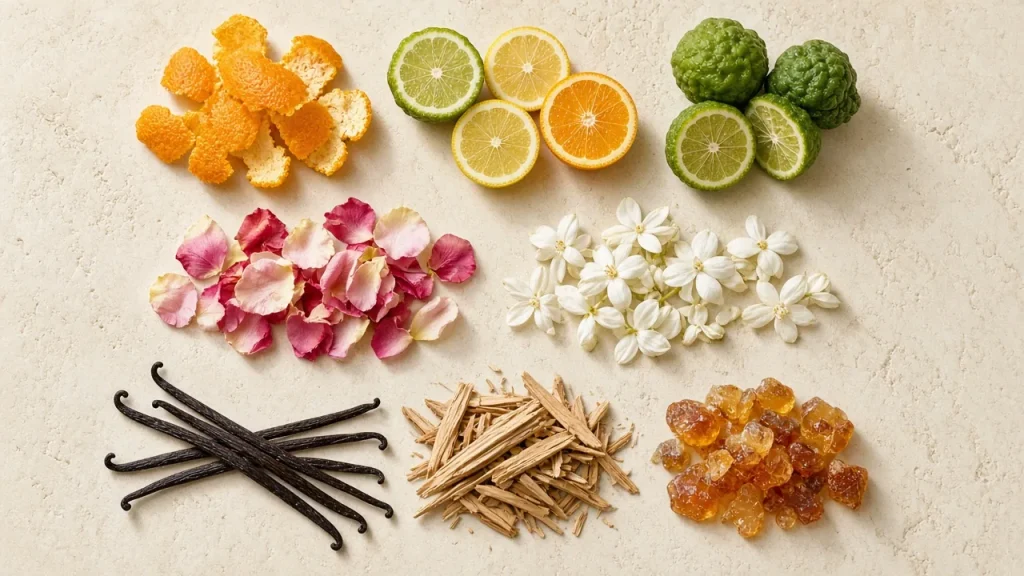
Almost every perfume description lists notes in three tiers: top, heart (or middle) and base. Shoppers often treat this list as a recipe, but it is really a timeline. It tells you what you will smell in the first minutes, what the scent becomes after an hour, and what is still on your skin in the evening. Once you can read a note pyramid, you will make far fewer disappointing purchases.
Why perfume changes over time
A perfume is a blend of dozens of materials that evaporate at different speeds. Small, light molecules (citrus oils, many herbs) evaporate quickly. Heavier molecules (woods, resins, musks, vanilla) evaporate slowly. As the lighter materials fade, the heavier ones become more noticeable. Perfumers describe this sequence with the pyramid:
- Top notes: what you smell first. Bright and attention-grabbing, usually fading within roughly 15 to 30 minutes.
- Heart notes: the main character, noticeable once the opening settles and present for several hours.
- Base notes: the foundation. They anchor the scent, help it last, and form the long “drydown”.
These timings are approximate. Concentration, skin, temperature and the specific materials all change how a scent behaves.
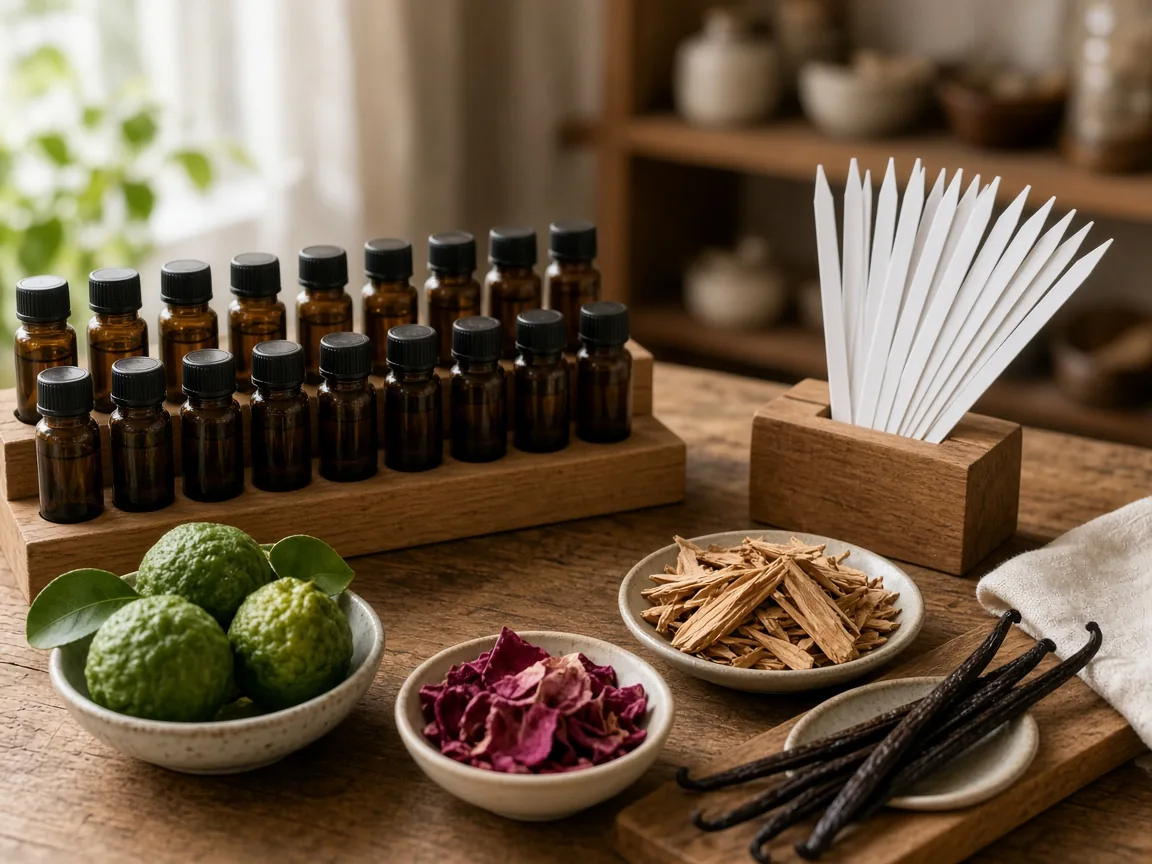
Typical notes at each level
Top notes
Citrus (bergamot, mandarin, lemon, grapefruit), light fruits (apple, pear, pineapple), aromatic herbs (lavender, mint) and sparkling spices (pink pepper, cardamom). Their job is to create a first impression.
Heart notes
Florals (rose, jasmine, orange blossom, iris), richer spices (cinnamon, nutmeg, saffron) and some woods. The heart defines the personality: floral, spicy, fruity or green.
Base notes
Woods (sandalwood, cedar, oud), resins and balsams (amber, labdanum, benzoin, frankincense), sweet materials (vanilla, tonka) and musk. Base notes are what people remember when you walk past them hours later.
Reading a real pyramid
Here are three scents from the same collection, with the note lists exactly as published on our product pages. Comparing them shows how much the pyramid reveals.
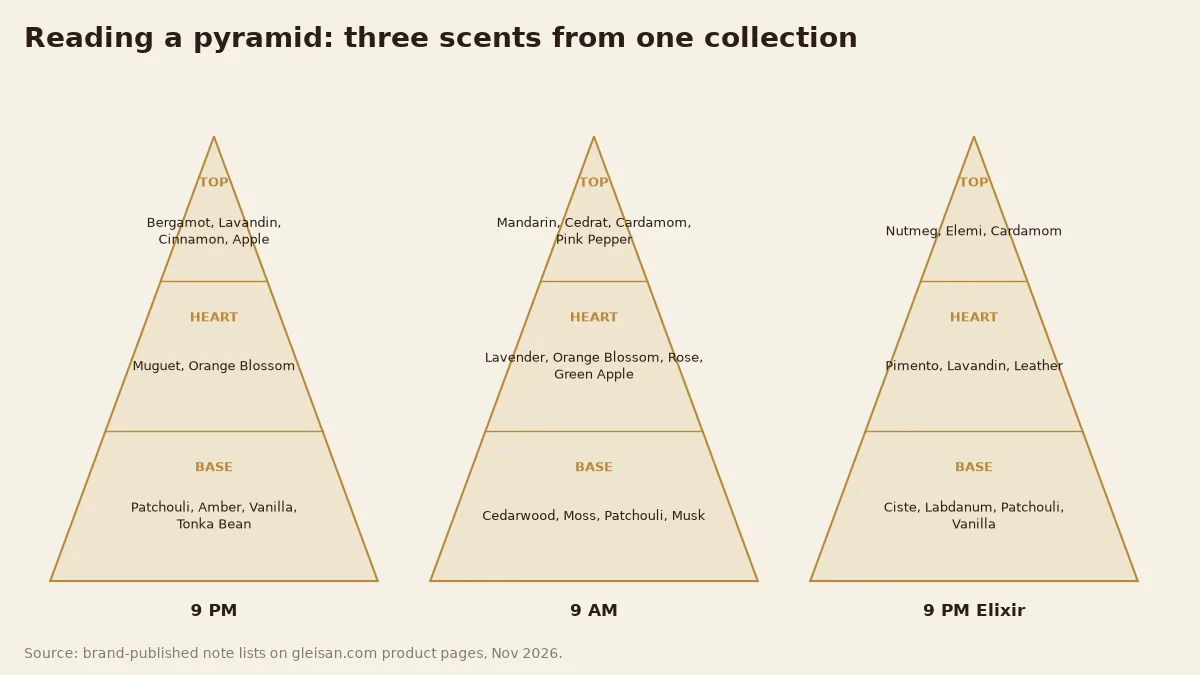
- Afnan 9 PM opens with bergamot, lavandin, cinnamon and apple, moves into muguet (lily of the valley) and orange blossom, and settles on patchouli, amber, vanilla and tonka bean. The sweet amber-vanilla base tells you it is an evening scent with a warm, sweet trail.
- 9 AM (same product page) opens with mandarin, cedrat, cardamom and pink pepper, keeps lavender, orange blossom, rose and green apple in the heart, and finishes on cedarwood, moss, patchouli and musk. No vanilla or amber in the base: expect something fresher and drier.
- 9 PM Elixir swaps the fruit for nutmeg, elemi and cardamom, puts leather in the heart, and ends on labdanum, cistus, patchouli and vanilla. That reads as darker and more resinous than 9 PM.
You can learn more about this family in our Afnan 9 Collection guide.
What the pyramid does not tell you
A note list is useful, but it has limits:
- Proportions are hidden. A note listed once may be a trace or the backbone.
- Notes are impressions, not ingredients. “Sea salt” or “white flowers” usually describe an accord made of many materials.
- Performance is missing. How long a scent lasts and how far it projects depend on the concentration and materials. Our guide to making perfume last longer covers what you can control.
- Some pyramids are flat. Many traditional oils and modern minimalist scents list the same notes at every level, or only a handful of notes. Oud oils, for instance, may list oud as top, heart and base. See what is oud.
Fragrance families: the shortcut
Notes group into families. If you know which family you like, you can scan pyramids quickly:
| Family | Typical notes | Feels like |
|---|---|---|
| Citrus / fresh | Bergamot, lemon, grapefruit, mint | Clean, light, daytime |
| Aromatic | Lavender, sage, rosemary | Crisp, barbershop |
| Floral | Rose, jasmine, peony, orange blossom | Romantic, soft |
| Spicy | Saffron, cardamom, cinnamon, pepper | Warm, vivid |
| Woody | Sandalwood, cedar, vetiver, oud | Dry, grounded |
| Amber / oriental | Amber, labdanum, benzoin, vanilla | Rich, enveloping |
| Gourmand | Vanilla, caramel, praline, coffee | Edible, sweet |
| Musky | White musk, ambrette | Soft, skin-like |
A few examples from our shelves show how families appear in a pyramid:
- Amber and gourmand: Lattafa Asad lists black pepper, tobacco and pineapple on top, patchouli, coffee and iris in the heart, and vanilla, amber, benzoin and labdanum in the base.
- Floral with a musky base: Swiss Arabian Traditional Collection in the Ward version lists rose and aldehydes on top, geranium and rose in the heart, and musk with woody notes underneath.
- Linear, single-idea pyramids: the Amouage Attars list just one note per tier. Rose Aqor, for example, is rose, then frankincense, then sandalwood.
Arabian perfumery leans heavily on the amber, woody and spicy families, which is why so many of our scents feel long-lasting. If “amber” confuses you, read amber vs ambergris.
How to use notes when shopping
- Look at the base first. It is what you will live with longest. If you dislike vanilla, a vanilla base will bother you more than a vanilla top note ever could.
- Check the heart for character. Rose, oud, leather or coffee in the heart tells you the mood.
- Treat the top as a bonus. A great opening that fades into a base you do not like is a poor buy.
- Compare pyramids side by side. Flankers (versions of one scent) often share a heart but change the top or base.
- Use your favourites as a map. List the notes that repeat across perfumes you love. Our how to choose a perfume guide turns this into a simple method.
Notes and climate
Base-heavy compositions with amber, oud and vanilla often feel richer in cool evenings and can become dense in strong heat. Citrus, aromatic and aquatic tops lift in warm weather but fade faster. That is why many people in the Gulf keep a fresh scent for daytime and a resinous one for night. For seasonal picks, see our best perfumes for hot weather, best winter perfumes and best vanilla perfumes.
Quick reference: how long each stage lasts
| Stage | Roughly noticeable | What to judge |
|---|---|---|
| Top | First 15 to 30 minutes | Your first impression only |
| Heart | From about 30 minutes to several hours | The main personality |
| Base | Several hours onward | What lingers on skin and clothes |
Frequently asked questions
Do all perfumes follow the pyramid? Most are described that way, but some are linear: they smell similar from start to finish. Perfume oils and attars are often more linear than sprays. Our guide on perfume oil vs eau de parfum explains why.
Why does a perfume smell different on me than on a friend? Skin chemistry, skin dryness, temperature and even what you ate can shift which notes stand out. Always test on your own skin.
What notes last the longest? Woods, resins, musks, ambers and vanilla are usually the most persistent. Citrus is usually the least.
Learning to read a pyramid takes a few minutes and saves a lot of guesswork. Next time you open a product page, read it from the bottom up. To explore by note, start from the notes index, or let the Scent Finder suggest a starting point.
Keep reading
- Perfume Oil vs Eau de Parfum: Which Should You Wear?
- How to Layer Perfume Oils and Sprays Without Making a Mess
- How to Make Perfume Last Longer in Hot Weather
- How to Choose a Perfume You Will Actually Wear
- Best Vanilla Perfumes from Arabian Houses
- Best Perfumes for Hot Weather: Fresh Picks That Hold Up
- Best Winter Perfumes: Warm Ambers, Spices and Smoke
- Best Arabian Perfumes for Women: A Shortlist by Mood
- What Is Oud? A Practical Guide to Oud in Perfume
- Amber vs Ambergris in Perfume: Not the Same Thing
Shop the story
Keep reading
17 Nov, 2026 · 6 min read
Christmas Perfume Gifts 2026: Ideas for Him, for Her and Last-Minute Shoppers
Warm, festive Arabian perfumes for him and for her, plus foolproof picks for last-minute shoppers who don't know the recipient's taste.
Read the story →
17 Nov, 2026 · 7 min read
Arabian Perfume Gift Guide: How to Pick a Scent for Someone Else
Buying perfume for someone else is easier than it looks. A practical guide to safe scent profiles, sets, oils and bakhoor, with picks for every kind of recipient.
Read the story →
17 Nov, 2026 · 7 min read
Perfume Gift Sets for Men: Sets Worth Giving
Which perfume gift set suits him? Travel sets, discovery kits and oud sets compared, with what's inside each and tips for choosing.
Read the story →