Notes from the house
Perfume Oil vs Eau de Parfum: Which Should You Wear?
Oils sit close to the skin and last; sprays project and evolve. Here is how perfume oil, attar, extrait, EDP and EDT really differ, and how to apply each one.
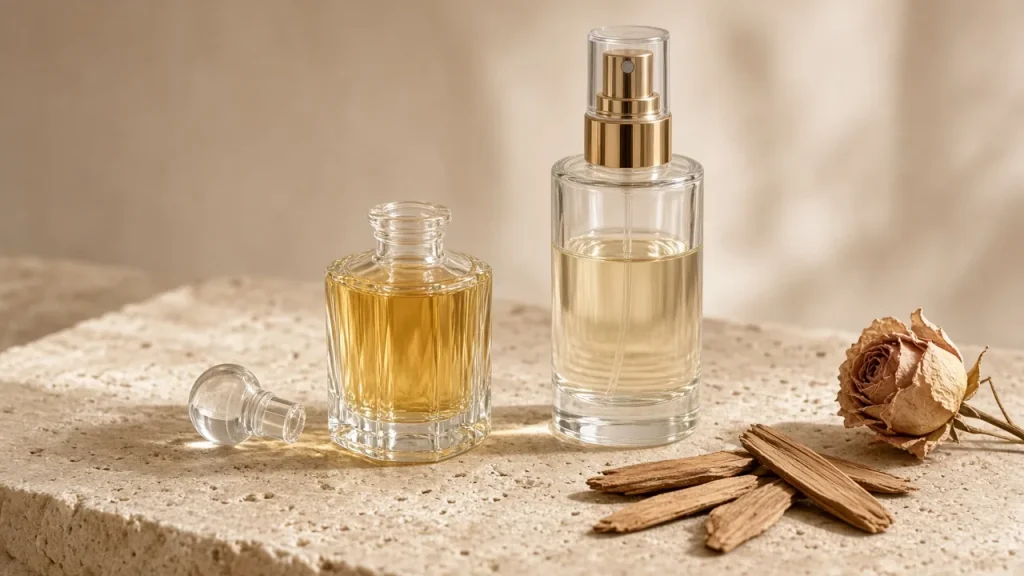
Walk into a perfume shop in Dubai and you will see two worlds side by side: tall spray bottles labelled eau de parfum and small, heavy bottles of concentrated oil, often sold by the tola. Both can smell beautiful, but they behave very differently on the skin. Here is how to choose between them, and how to wear each one well.
The short answer
- Choose eau de parfum (EDP) if you want a scent that projects, evolves through clear top, heart and base stages, and is easy to apply.
- Choose perfume oil if you want something intimate that stays close to the skin, lasts well, and can be layered under other scents.
Many people in the Gulf use both: an oil as a base, and a spray on top.
What perfume oil is
A perfume oil is a fragrance carried in oil instead of alcohol. It may be a blend of aromatic materials diluted in a neutral oil, or a very concentrated mukhallat (blend) worn almost neat. Because there is no alcohol to lift the scent into the air, oils sit closer to the body and release more slowly.
What about attar?
Attar (or ittar) traditionally means natural materials, such as rose, distilled into a base of sandalwood oil, a method still associated with Kannauj in India. Today the word is used more loosely across the Gulf and South Asia for any concentrated, alcohol-free perfume oil. If you want the traditional style, look for attars where the note list is short and natural-sounding. Our best attar and perfume oils shortlist goes further.
Units you will see
Traditional oils are often sold by the tola, a South Asian unit of about 11.7 grams. Shops commonly bottle a tola as roughly 12 ml, with half and quarter tolas for smaller sizes. You will see this on, for example, Arabian Oud Classic Oils.
What eau de parfum is
An eau de parfum is a fragrance concentrate dissolved in perfumer’s alcohol, with a little water. When you spray it, the alcohol evaporates within seconds and carries the scent outward. That gives EDP its projection, the “air” around you, and the clear sequence of top, heart and base notes described in fragrance notes explained.
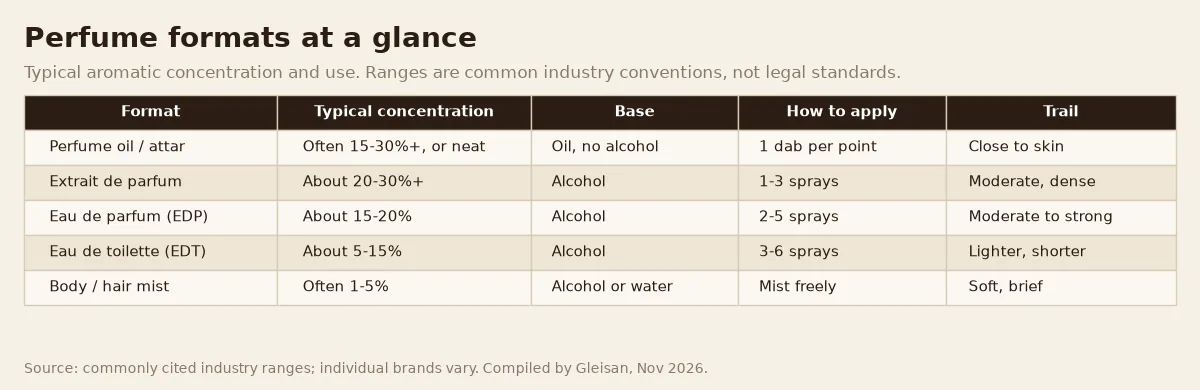
Other alcohol-based formats differ mainly in concentration:
Side-by-side: oil vs spray
| Perfume oil | Eau de parfum | |
|---|---|---|
| Projection | Low to moderate; people notice it up close | Moderate to strong, especially in the first hours |
| Longevity | Often long on skin; varies by blend | Varies widely; usually several hours |
| Evolution | Often more linear | Clear top, heart and base stages |
| Application | Dab with a rod or roller | Spray from about 15 cm away |
| Travel | Small, leak-resistant bottles; no alcohol | Larger bottles; alcohol-based |
| Feel on skin | Slightly oily, moisturising | Dry within seconds |
| Best for | Close wear, layering, sensitive settings | A clear scent trail, compliments, evenings out |
The same scent in both formats
Some houses release the same fragrance as an oil and a spray, which is the clearest way to compare. Swiss Arabian Shaghaf and the Swiss Arabian Concentrated Oils range both include Shaghaf Oud Ahmar, with the same published notes: bergamot, iris, freesia, melon and peach on top; tonka, amber, apple and rose in the heart; and cedarwood, sandalwood, amber, vanilla, powdery musk and oud in the base. In the spray you will notice the fruity top more; in the oil, the creamy amber-musk base dominates sooner.
Similarly, Afnan Abiyad offers Abiyad Mukhallat both as an eau de parfum and as a concentrated perfume oil, built on saffron, wood, amber, musk, rose, incense and oud.
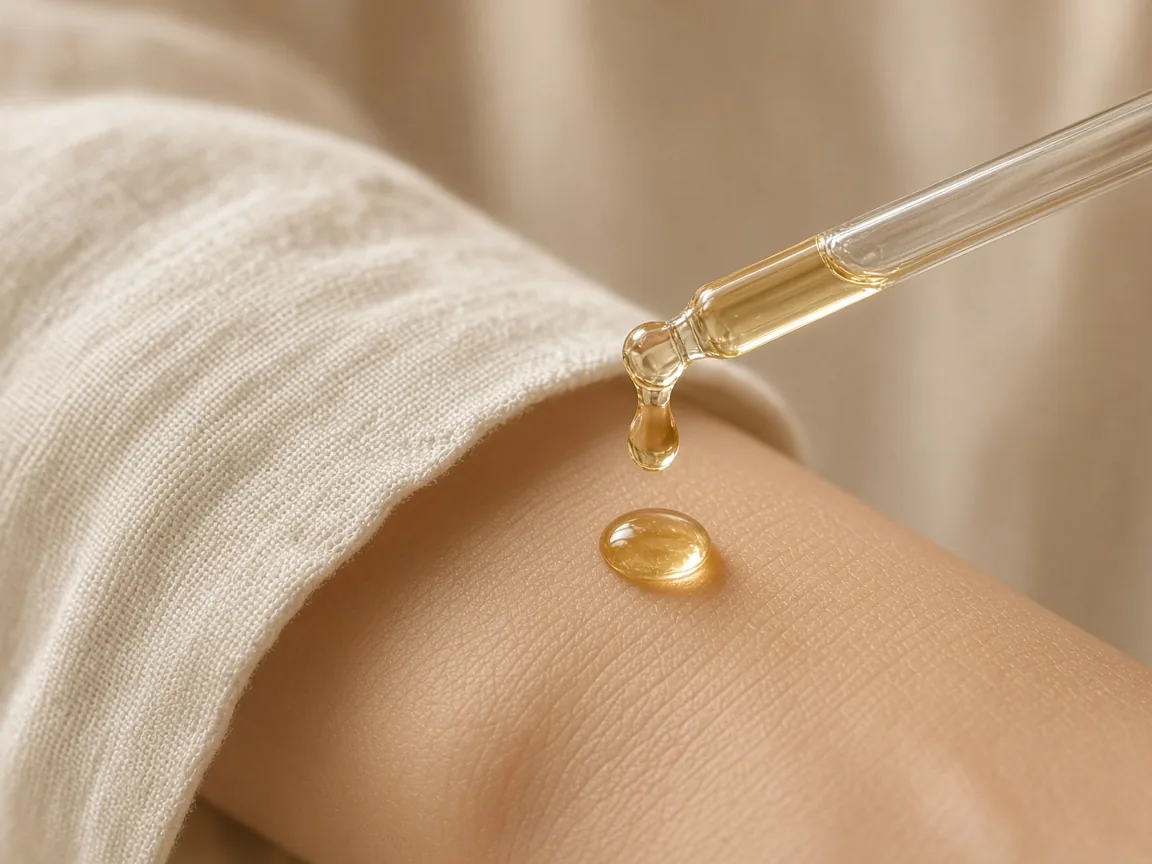
How to apply perfume oil
- Apply to clean, moisturised skin. Oil holds better on skin that is not dry.
- Use one small dab per point. Inner wrists, behind the ears, the base of the throat. Do not rub wrists together hard; press lightly.
- Try the beard or hair ends (a tiny amount on fingertips) for a longer-lasting, gentle trail.
- Avoid delicate fabrics. Oils can mark silk and light-coloured clothes.
- Wait 20 minutes before judging. Oils open slowly.
How to apply eau de parfum
- Spray from about 15 cm onto pulse points and the chest or neck.
- Do not rub. Rubbing heats the skin and can flatten the top notes.
- Two to five sprays is a normal range for most EDPs; reduce for very strong scents and in offices.
- Clothes hold scent longer than skin, especially in heat. Test on an inconspicuous area first.
More tips are in how to make perfume last longer in hot weather.
Layering oil and spray
The Gulf habit of wearing oil under spray is not just tradition; it works. The oil gives a long-lasting base and the spray adds projection. A classic pairing is an oud or musk oil under a rose or amber spray. Apply the oil first, wait a few minutes, then spray. Our guide on how to layer perfume oils lists combinations that work. If you are curious about oud oil itself, start with what is oud.
Which should you choose?
- For the office or close company: an oil, or one or two sprays of a soft EDP.
- For evenings and events: an EDP or extrait, possibly over an oil.
- For travel: oils are compact, alcohol-free and easy to carry.
- For sensitive skin: some people find alcohol drying; oils can be gentler. Patch-test either way.
- For gifting: sprays are easier for people new to Arabian perfume; oils suit those who already know the style.
Frequently asked questions
Does perfume oil last longer than EDP? Often on skin, yes, because oil evaporates slowly, but it projects less. A strong EDP can be noticed by others for longer even if an oil lingers closer to the skin.
Is EDP stronger than EDT? Usually it has a higher concentration, but strength also depends on the materials. Some EDTs project more than some EDPs.
Can I spray an oil? Use the applicator the oil comes with. Oils are not designed for atomisers.
Is attar the same as perfume oil? Every attar is a perfume oil, but not every perfume oil is an attar in the traditional sense.
Both formats belong in a fragrance wardrobe. If you have only ever worn sprays, a single oil, dabbed under your usual scent, is the easiest place to start.
Keep reading
Shop the story
Keep reading
17 Nov, 2026 · 6 min read
Christmas Perfume Gifts 2026: Ideas for Him, for Her and Last-Minute Shoppers
Warm, festive Arabian perfumes for him and for her, plus foolproof picks for last-minute shoppers who don't know the recipient's taste.
Read the story →
17 Nov, 2026 · 7 min read
Arabian Perfume Gift Guide: How to Pick a Scent for Someone Else
Buying perfume for someone else is easier than it looks. A practical guide to safe scent profiles, sets, oils and bakhoor, with picks for every kind of recipient.
Read the story →
17 Nov, 2026 · 7 min read
Perfume Gift Sets for Men: Sets Worth Giving
Which perfume gift set suits him? Travel sets, discovery kits and oud sets compared, with what's inside each and tips for choosing.
Read the story →